A loading dock can look quiet while hiding serious risks. A trailer may creep forward. A dock plate may shift. A wet floor can turn one rushed step into a severe injury. These details explain why the question “what safety standards are required for dock systems” deserves careful, practical attention.
Occupational-safety expert David Michaels has stated, “There is no such thing as an acceptable level of workplace injury.” His principle fits dock operations closely. In the United States, employers commonly review OSHA requirements for dockboards, powered industrial trucks, walking-working surfaces, machine guarding, and fall protection. ANSI MH30 standards can also help organizations evaluate dock levelers and related equipment. Requirements may differ by location, equipment type, and workplace conditions.
Compliance is more than installing a barrier or posting a warning sign. A reliable program checks trailer restraints, wheel chocks, dock lights, vehicle separation, guardrails, emergency exits, and inspection records. Workers need understandable training, not merely a signature on a form. Supervisors should watch real loading activity, including rushed deliveries and poorly positioned trailers.
Some guidance remains open to interpretation. That is worth admitting. A standard may identify a hazard without solving every layout problem. Older docks can also contain weaknesses that a checklist misses. This article will examine applicable standards, practical controls, inspection habits, and training expectations. It will also consider where common dock procedures fall short, because safe design begins with honest observation.
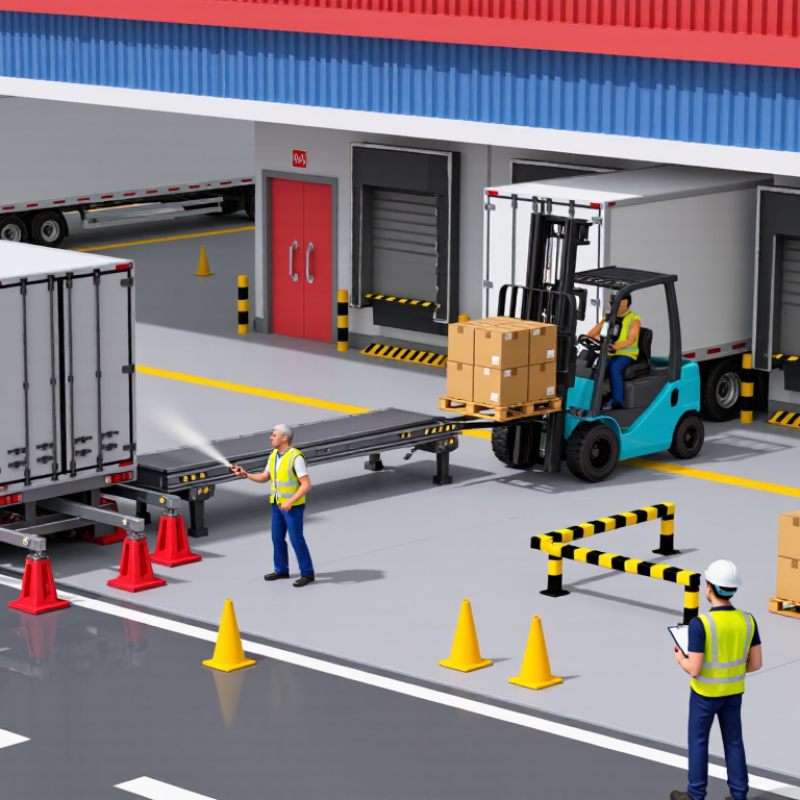
Dock-system safety begins with the legal baseline in OSHA 1910.26. This rule addresses dockboards used between loading platforms and vehicles. Each board must withstand the expected load, remain stable, and resist slipping or displacement. Portable dockboards also need secure handholds or other safe handling features. In practice, a supervisor should inspect the lip, hinges, welds, surface, and rated capacity before use. A damaged plate may look acceptable from a distance. It may fail under a loaded pallet jack.
ANSI MH30.1 expands the engineering view. It covers dock-leveling systems, including design, performance, installation, inspection, and maintenance considerations. The standard supports safer interfaces between a building floor, dock leveler, and trailer bed. It does not replace OSHA requirements. It helps translate them into measurable equipment practices. The Bureau of Labor Statistics reported 1,495 fatal injuries among transportation and material-moving occupations in 2023. That figure is not dock-specific, but it shows the exposure surrounding loading operations. OSHA also identifies struck-by and caught-between hazards as serious workplace risks. A clear exclusion zone, working trailer restraint, and visible communication can reduce those risks.
Daily checks remain essential. Verify that the trailer cannot move, the leveler bridges the gap, and the deck supports the planned load. Keep the platform dry and free from loose shrink wrap. Documentation is often weaker than the equipment. That deserves honest review. A signed checklist cannot prove that an inspection was careful. Training should include real loading conditions, not only classroom slides.
What Safety Standards Are Required for Dock Systems?
Set Minimum Loading Capacity, Including 67% Dockboard Safety-Factor Criteria
Dock systems must support more than the forklift’s advertised weight. OSHA 29 CFR 1910.26 requires dockboards to withstand loading operations and remain secured against slipping. ANSI MH30.1 also emphasizes rated capacity, structural performance, and controlled use. Capacity should include the forklift, operator, load, and impact forces during entry.
A practical specification begins with the heaviest realistic combination. Then apply a conservative 67% operating limit to the dockboard’s rated capacity. This means routine loads should not exceed two-thirds of the posted rating. The 67% figure is a procurement and risk-control criterion, not a universal OSHA requirement. Engineers should verify whether local codes or project specifications require a different factor. A 20,000-pound board, for example, would carry no more than 13,400 pounds under this rule.
Small details matter. Check the plate before each shift. Inspect welds, hinges, curbs, and lip edges. Keep the trailer restrained, and prevent vehicle movement during loading. The U.S. Bureau of Labor Statistics reported 865 workplace fatalities from falls, slips, and trips in 2022. Dock edges create a concentrated version of that hazard. Liberty Mutual’s 2023 Workplace Safety Index also estimated $10.7 billion in direct costs from workplace falls, slips, and trips in 2020. These figures do not isolate docks, but they show why capacity controls deserve attention. My practical concern is simple: posted ratings are often trusted more than actual inspection evidence. That assumption needs challenging.
Dock safety begins with restraints, ramps, and guards working as one system. OSHA 1910.178 requires powered industrial truck operators to set brakes and use wheel chocks or positive restraints during loading. A restraint should match the trailer’s rear impact area. It must also show a clear operating status from the dock floor.
Ramps and dockboards need enough capacity for the truck, load, and expected traffic. OSHA 1910.178 requires dockboards to be secured against movement and equipped with safe handling features. ANSI guidance adds practical design details, including rated capacity plates, controlled slopes, proper lip support, and regular inspections. Keep the ramp surface dry, clean, and free from loose packaging. Small debris can change a smooth crossing into a sudden stop.
Guards protect open dock edges, exposed sides, and nearby pedestrian paths. OSHA walking-working-surface rules require protection where falls could occur, while ANSI dock guidance supports visible barriers, warning markings, and controlled access. Guard openings must not invite a worker or pallet to pass through. Not decorative.
In the field, inspections often reveal a harder problem: equipment exists, but nobody checks it consistently. A restraint may engage while its indicator stays dark. A guard may be strong but poorly positioned. Record these defects, remove unsafe equipment from service, and train operators to report changes immediately. Standards establish the baseline. Site conditions determine whether that baseline is actually enough.
| Dock System Area | Required or Recommended Control | OSHA Reference | ANSI/ITSDF Alignment | Verification Point |
|---|---|---|---|---|
| Vehicle movement control | Set the vehicle brakes and prevent trailer movement before loading or unloading. Use wheel chocks, a mechanical vehicle restraint, or another effective control appropriate to the operation. | 29 CFR 1910.178(k)(1) | Supports controlled dock operations, vehicle immobilization, and prevention of unintended separation from the dock. | Confirm the restraint or chocking procedure is applied before a forklift enters the trailer. |
| Trailer support | Provide fixed jacks or equivalent support when a semitrailer is not coupled to a tractor and the loading operation could create a hazardous upward or downward movement. | 29 CFR 1910.178(k)(2) | Consistent with maintaining trailer stability and preventing dockboard movement or trailer tipping during material handling. | Inspect support equipment for capacity, placement, damage, and stable contact with the trailer. |
| Dockboard capacity | Use a dockboard that is strong enough for the expected combined load of the forklift, pedestrians, cargo, and other equipment. Do not exceed the marked rated capacity. | 29 CFR 1910.178(m)(1) and applicable dockboard provisions | ANSI/ITSDF B56.1 addresses safe use of ramps and dockboards, including rated capacity, stability, condition, and operating limitations. | Verify the capacity marking is legible and exceeds the maximum planned load. |
| Dockboard securing | Secure the dockboard before it is operated over. Portable dockboards must be secured by chains or other effective means to prevent slipping or movement. | 29 CFR 1910.178(m)(6) and 1910.178(m)(7) | Aligns with the requirement to prevent dockboard displacement, loss of bearing, or unintended separation from the dock or trailer. | Check retaining chains, pins, lips, stops, hinges, and contact surfaces before each use. |
| Dockboard condition | Remove damaged or defective dockboards from service until repaired or replaced. Keep the surface free of conditions that could cause loss of traction or control. | 29 CFR 1910.178(p)(1) and applicable walking-working-surface requirements | Supports inspection for cracks, deformation, excessive wear, damaged welds, loose hardware, and inadequate traction. | Document inspections and immediately tag or isolate equipment that fails inspection. |
| Ramp slope and transition | Use a ramp or dockboard with a stable transition and a slope suitable for the powered industrial truck, load, surface, and operating conditions. Operate at a controlled speed. | 29 CFR 1910.178(n) and 1910.178(m) | ANSI/ITSDF B56.1 emphasizes controlled travel, appropriate ramp conditions, adequate clearance, and operation within equipment limitations. | Confirm the ramp is aligned, fully supported, free from abrupt edges, and suitable for the equipment and load. |
| Forklift operation on ramps | Keep the load upgrade when traveling with a load on a grade. When traveling without a load, keep the forks downgrade where required by the operating condition. Maintain control and do not turn on the ramp. | 29 CFR 1910.178(n)(7) | Consistent with safe travel practices for grades, ramps, load stability, visibility, and traction. | Include ramp travel rules in operator training and observe compliance during inspections. |
| Open dock edges | Protect employees from falls at unprotected sides and edges of walking-working surfaces that are 4 feet or more above a lower level, except where a specific OSHA exception applies. | 29 CFR 1910.23(c)(1) | Supports the use of guardrails, barriers, chains, gates, or equivalent systems designed for the specific dock configuration and task. | Ensure protection is installed whenever the dock position is open and no vehicle or dockboard provides a safe working surface. |
| Guardrail dimensions | Guardrail systems generally require a top edge height of 42 inches, plus or minus 3 inches, with an intermediate member or equivalent protection. The system must withstand the applicable OSHA force requirements. | 29 CFR 1910.29(b) | Aligns with the use of structurally adequate edge protection and controlled access around dock openings. | Inspect posts, rails, gates, chains, anchors, and connections for strength, stability, and damage. |
| Trailer entry and visibility | Maintain adequate lighting and inspect the trailer floor and working area before entry. Do not operate a forklift on a floor that cannot support the equipment and load. | 29 CFR 1910.178(k)(3), 1910.178(h), and 1910.178(n) | Consistent with pre-use assessment of floor condition, visibility, ventilation, clearances, and operating hazards. | Verify the floor is sound, the path is clear, lighting is sufficient, and the operator has adequate visibility. |
| Procedures and training | Train and evaluate powered industrial truck operators before authorization and provide refresher training when unsafe operation, changes in conditions, or other qualifying events occur. | 29 CFR 1910.178(l) | Supports documented operating procedures covering restraints, dockboards, ramps, guards, inspections, communication, and emergency actions. | Maintain training records and review procedures after equipment, layout, vehicle, or process changes. |
A dock leveler is a moving bridge, not merely a steel platform. EN 1398 sets safety requirements for design, installation, operation, and maintenance. Procurement teams should verify clear evidence of compliance. The evidence should identify rated load, safety devices, guarding, hydraulic controls, and emergency stopping functions. It should also confirm a 10,000-cycle endurance test under defined loading conditions. Ask for the test method, applied load, cycle count, and pass criteria. A certificate without test details is weak evidence.
The risk is practical. HSE’s Fatal Injuries in Great Britain, 2023/24, recorded 138 worker deaths across all workplace sectors. Eurostat’s 2022 Accidents at Work data reported roughly 3.5 million non-fatal EU workplace accidents requiring at least four days away from work. These figures are not dock-specific, but they show why loading areas deserve disciplined controls. In real inspections, poor maintenance often appears before structural failure: worn hinges, damaged lips, oil leaks, and missing warning labels. Paper compliance can still hide poor installation.
Tips: Check the EN 1398 declaration and the 10,000-cycle report. Inspect the pit, lip, bumpers, restraints, and controls together. Record inspection dates and defects. Confirm operators understand safe loading limits. Do not rely on a single annual check. A short daily visual inspection may reveal problems earlier, although this simple step is often missed. Ask an independent competent person to review unclear evidence.
What Safety Standards Are Required for Dock Systems?
Annual compliance depends on more than a signed inspection sheet. A competent inspector should examine dock levelers, vehicle restraints, seals, bumpers, doors, controls, and warning lights. Look for cracked welds, hydraulic leaks, frayed cables, loose bolts, and damaged labels. Small defects can become serious when a trailer shifts unexpectedly.
Inspection results should include the equipment location, date, findings, corrective actions, and the responsible person. Keep records where supervisors and maintenance staff can access them quickly. Routine checks are also necessary between annual reviews. A bent lip or failed restraint may appear after one busy shift. Annual review alone is not enough.
Training must match each worker’s actual task. Operators should practice safe trailer approach, restraint verification, communication, and controlled loading. They should know when to stop work. Maintenance personnel need a written lockout procedure covering electrical, hydraulic, mechanical, and stored energy. They must isolate every energy source, apply personal locks and tags, and verify zero movement before entering a hazard area. Release devices only after guards are replaced and the area is clear.
Training attendance is useful, but observed performance is stronger evidence. Ask workers to demonstrate the procedure. Correct gaps immediately. Some programs look complete on paper yet remain weak during a rushed shift. That uncomfortable finding deserves attention, not concealment. Review procedures after equipment changes, incidents, or repeated near misses, and confirm that local safety requirements are reflected in the annual audit.
Establish inspection, training, and lockout procedures for annual compliance.
How to read this chart: The chart summarizes selected U.S. OSHA baseline frequencies. A value of 0 means the inspection is required before each use rather than at a fixed monthly interval. Lockout/tagout procedures require a periodic inspection at least annually, while powered industrial truck operators must be evaluated at least once every three years.
Sources: OSHA 29 CFR 1910.26(a)(2), 29 CFR 1910.147(c)(6), and 29 CFR 1910.178(l)(4).
It covers design, installation, operation, and maintenance safety. Check load ratings, guarding, controls, and emergency stopping functions.
It shows endurance under defined loading conditions. Request the applied load, test method, cycle count, and pass criteria.
Not always. A certificate without test details provides weak assurance. Ask for supporting reports and clear equipment identification.
Check hinges, lips, bumpers, restraints, controls, labels, and oil leaks. Look closely. Small defects may appear after one busy shift.
Record the location, inspection date, findings, corrective actions, and responsible person. Keep records easy for supervisors and maintenance staff to access.
Equipment can become damaged quickly. A bent lip or failed restraint may appear before the next annual review.
They should practice trailer approach, restraint checks, communication, and controlled loading. They must know when to stop work.
Isolate electrical, hydraulic, mechanical, and stored energy. Apply personal locks and tags. Verify zero movement before entering the hazard area.
Ask workers to demonstrate the procedure. Observed performance is stronger evidence than attendance records. Paperwork can look complete, but practice may still be weak.
Review them after equipment changes, incidents, or repeated near misses. An independent competent person should examine unclear evidence.
Dock-system safety depends on applying clear requirements to every part of loading and unloading operations. The program should define the scope of compliance under OSHA 1910.26 and ANSI MH30.1, establish minimum loading capacities, and apply the 67% dockboard safety-factor criterion when evaluating equipment. It should also specify suitable restraints, ramps, guards, and related protections in accordance with OSHA 1910.178 and applicable ANSI guidance.
To answer what safety standards are required for dock systems, facilities should verify that dock levelers meet EN 1398 safety provisions and complete the required 10,000-cycle performance testing. Annual compliance should include documented inspections of boards, levelers, restraints, ramps, guards, and structural components. Employees must receive practical training on safe loading procedures, equipment limitations, hazard recognition, and emergency actions. Clear lockout procedures should be used whenever maintenance or repairs could expose workers to stored energy or moving equipment. Together, these measures create a consistent system for preventing falls, vehicle movement, overloads, and equipment-related injuries.

Spare PartPro